
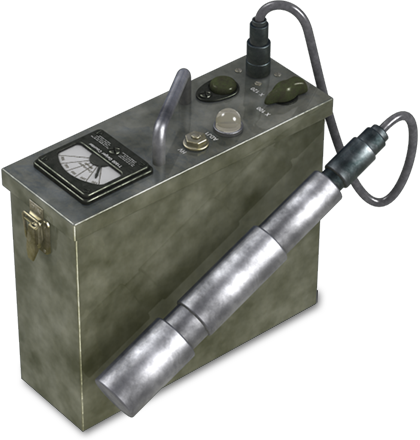
Description
In the early 20th century, many scientists were looking for ways to measure radiation, which had been discovered near the end of the previous century. Radioactivity is the spontaneous emission of radiation (waves or subatomic particles) exhibited by certain elements due to either the unstable nuclei of its atoms or a nuclear reaction. To investigate radioactivity adequately, researchers needed to detect and quantify radiation. There was, however, one problem: Radiation cannot be detected by the unaided human senses.
Enter Hans Geiger, a young German scientist on the staff at the University of Manchester. Having received his Ph.D. from the University of Erlangen in 1906, he moved to England and began studying radioactive emissions with up-and-coming nuclear physicist Ernest Rutherford, chair of the physics department. Rutherford had an ardent interest in special particles, called “alpha particles,” that are emitted from radioactive materials (alpha particles are nuclei of helium-4 atoms). Knowing that alpha particles can travel through very thin solids, Rutherford and Geiger developed a method of detecting the particles using gold foil and a screen: After passing through the foil, the particles hit the screen, producing on impact barely detectable flashes of light. The scientists (Geiger especially) spent innumerable hours counting these flashes in a dark room. As Rutherford recounted in a 1908 letter to a friend, “Geiger is a good man and work[s] like a slave…. [He] is a demon at the work and could count at intervals for a whole night without disturbing his equanimity.”


Reviews
There are no reviews yet.